Christmas Season, Christian Artists

With Christmas just around the corner I thought I would share with you some contemporary Christian artists (or art with Christian imagery).  Some of these artists are well known names you may recognize and others are up and coming.  They are all exceptional and well worth exploring further.  Click on the artwork to learn more about the artist and their art.  I'll be back with a post the first Friday in January.  Have a very merry Christmas and may God bless you and your family this new year.


Jean-Marie Pirot-Arcabas


Ron DiCianni

His 12'x 40’oil on canvas mural “The Resurrection”
*See more in
This Week's Videos at the bottom*


J Christopher White


Chidi Okoye


Chris Koelle
some of his work with Christian Imagery (positive or negative)

Thomas Kinkade
America's most collected living artist


          In a nut shell

   1-Enjoy the art
   2-Have a merry Christmas
   3-See you next year


Quotes
Thomas Kinkade


“My mission as an artist is to create glimpses of a world that is tranquil, peaceful and full of the beauty of God's creation. That's what I mean when I talk about sharing the light.”

“Balance, peace, and joy are the fruit of a successful life. It starts with recognizing your talents and finding ways to serve others by using them.”


Videos

Christain artist Ron DiCianni shares his thoughts about painting "The Resurrection" with close-ups and details of this remarkable forty foot oil on canvas.


A Charlie Brown Christmas by Charles Schulz (writer & artist) first aired on television in1965.  This is the classic meaning of Christmas scene were Linus recites Luke 2:8-14,


Here is a great version of "Have Yourself A Merry Little Christmas" performed by  Katie Melua a few years back.

Directed Randomness

When you are in the process of developing new concepts and ideas, using some form of directed randomness can be very helpful. There are many ways directed randomness can be introduced into your creative process.  It's best used when you are at a point where you want to open new doors to entirely new areas of thinking.

To better understand how directed randomness works consider the following.  I have a small library in my studio that is filled with books I have accumulated over the years.  When I am working on a project and I decide I could use some directed randomness I will stand in front of a book shelf, close my eyes and randomly select a book.  With my eyes still closed I will arbitrarily open the book to a section. I open my eyes and begin to scan the section I have found.  I then focus my mind on finding useful parallels and connections between the random passages and images and my project.


By selectively introducing this randomness into your creative process you are able to focus your problem-solving brain on entirely new areas.  It’s a way of willfully kicking your brain outside of the box it currently resides.  As you practice this technique you will better understand how and why it is so valuable.  As you come to understand why this method works so well you can begin creating your own techniques to meet your unique challenges.

Another approach I like that helps me achieve this controlled randomness is a haphazard online search with preset rules.
For example:
     1-Have an objective in mind.
     2-Go to Google’s main search page and type into the search box any two words that come to mind. 
     3-Go to the fourth and fifth words of the fourth search result and type them into the search box.
     4-Go down the new search results page and brainstorm connections to your objective.
     5-When you discover one that really works go with it.

A quick demonstration of how this might work:
   1-Objective: to improve a paperclip
   2-Two random words that came to mind: “Light Shade”
   3-4th & 5th words that appeared in the 4th search result: “Two Disc”
   4-Brainstormed connections to objective from search results page:
      -Paper clips could be shaped like a musical note
      -Paper clips could be shaped like famous musician caricatures
      -Small square paper clips could have famous musical CD art on them

This random online brainstorm demo took about four minutes and it allowed my mind to consider completely new areas of thought that might help achieve my objective.  Give this method a try and let the new connections propel your imagination into genuine discovery and innovation and you will be amazed by this methods productive value.


          In a nut shell

   1-Use directed randomness
   2-Open a book randomly to a page
   3-Scan the page for useful connections to your project
   4-Do the same with random online searches
   5-Understand why it works
   6-Create your own directed randomness approach


Quotes
Roger Bannister


(Talking about breaking the four-minute mile.)

“No longer conscious of my movement, I discovered a new unity with nature.  I had found a new source of power and beauty, and a source I never dreamt existed.


Videos

David C Roy's kinetic sculptures are wooden machines that are wound up for hours of uniquely interesting motion.  To explore his work further I recommend his website Wood That Works.


I stumbled across this video recently and thought it demonstrated some interesting optical illusions with movement.  It gave me some interesting ideas and I thought it might spark some creative ideas for you.  See what you think.

Make Something

Creative thinking actually increases the brains health and elasticity.  A great way to develop creative thinking is to make something new.  Dr. Daniel G. Amen (physician, psychiatrist, clinical neuroscientist, and bestselling author) says that for brain health “it is important to work your brain often”.  He recommends “learning something new and different” on a daily basis.  One way to do this is to make something new.  It can be a small project or an ambitious one as long as it requires new areas of learning and presents you with new challenges.

What should you make?
What would you like to make?
Just about anything that interests you will work.  Here are a few random ideas to get your brain in gear.  Click on one to learn more or let them open the door to a good online search that leads you to a worthwhile project.

Make A Guitar
Building A Solid-body Guitar


Make An Igloo
How To Make An Igloo


Make An Online Painting
Free Artpad Online Painter


Make A Camera
How To Make A Pinhole Camera

Make A Sports Garage
Garage Mahal Sports Garage


Make A Sunclock
Making A Sunclock
Optical Sphere Sunclock


Make A Flow Chart
Easy To Use Diagram Software
Free Online


Make A New Color Scheme
Kuler: Color Selection Tool
Free Online
Make A Fried Turkey
How to fry a turkey
Without burning down the house

Make A Paper Craft Project
Make a Papercraft LED Lantern

I didn’t know what a Freedom Gundam was,
but the following video is pretty impressive.


Make A Tiny Sculpture
Unbelievable! and he was able to sell his 
life's work (up to that point) for $20 million.


Make A Large Sculpture
This one is unusual and it demonstrates
the remarkable skills of hyper-realist 
sculptor Ron Mueck.


The following website links may help you choose a project as well.

As you engage in the making of something new recognize the mental stimulation it produces as well as the mental discipline that it takes to follow it through to completion (especially if you chose something more ambitious).  Each stage in the making process presents new challenges for you and your brain to overcome.  Each challenge overcome promotes a sharper brain and permanent new understandings that can branch out into new concepts and ideas.  You also strengthen your will to be a finisher and in today’s world that is an enormous advantage.
Choose something interesting but don’t get bogged down in the choice.  If necessary give yourself a deadline in the choosing process and always give yourself a deadline for the project you choose.  It only takes minutes to begin the process so take the time to make something new and experience the inevitable personal improvement that comes with stepping outside your comfort zone and creating.  Thomas Edison said “Opportunity is missed by most people because it is dressed in overalls and looks like work."  Don't miss out.

          In a nut shell

   1-Make something new
   2-Choose a project
   3-Set a deadline and make it
   4-Be sure to finish it


Quotes
Zaha Hadid

“You have to be very focused and work very hard, but it is not about working hard without knowing what your aim is! You really have to have a goal. The goal posts might shift, but you should have a goal, know what it is that you are trying to find out."


Videos

Reuben Margolin is a kinetic sculptor creating waves in motion.


Tim Kaiser is a musician that now makes experimental Instruments for original ambient sound.

Process It

When considering the creative process, creatively consider making new processes.  A new process will take your mind to new places and it can be a new way to look at old problems.  Stand back from your current methods and processes.  Break them down and analyze them.  With an understanding of them begin to develop and design entirely new ones.  Experiment with systems that have never been tried before.  Outline or describe the new approach and see where it takes you.  As you experience your new processes you can refine and improve them.  You will find that each new process gives you fresh perspectives for numerous creative challenges.


There are many tried and true creative processes that have been developed as well and they too are worth exploring.

The famous artist/musician David Bowie occasionally speaks about a method he likes to use when writing songs. He writes down words that he finds intriguing and collects them up over time. He then cuts the words up so that each word is on an individual piece of paper. He spreads the words out in front of him and begins to experiment with different; combinations, orders, rhythms and so on.  He eventually works these into lyrics, songs and music.

.                   Albrech Durer Wood Cut                                       Leonardo da Vinci
Fifteenth century Leon Battista Alberti developed a process for artists to view and grasp the correct perspective of a scene by observing it through a thin veil with a see-through grid (as seen in the Albrech Durer image above).  Leonardo da Vinci used and further developed similar contraptions as did many artists of the time.

Dr. Yoshiro Nakamatsu (the famous Japanese inventor) likes to submerge himself underwater with a pad and underwater writing instrument.  He feels it helps him think more creatively and he is able to write his thoughts down as they come.

Explore process as you develop your work.  Research the processes of people that you respect.  Try them, refine them and make your own unique systems to enhance your creativity.  It’s always an interesting exercise and it rarely disappoints in producing great results.


          In a nut shell

   1-Consider new creative processes
   2-Analyze your current processes
   3-Research other people’s processes
   4-Make and use new ones
   5-Refine and improve them


Quotes
David Bowie

“There’s nothing more embarrassing than watching somebody who doesn’t love what they do, but does it because they believe that’s the way they’re going to be loved.”

“I've never responded well to entrenched negative thinking.”


Videos

Yoshiro Nakamatsu holds a world record for receiving the most patents (over 3000).  From the karaoke machine to the DVD he has played a major role in many of the inventions we are all familiar with.  In the following video clip he shares one of his techniques for promoting “higher” inventive thinking.  It’s a clip from the documentary The Invention of Dr Nakamats.  He’s funny but he’s no joke.


Daniel Rozin is an interactive digital artist.  He creates installations and sculptures that respond to the viewer in very unique ways.  He is also the owner of Smoothware Design, a software company that makes his  interactive art possible.


Creativity and Context

In a previous post I explained the value of sparking the brain’s natural tendency to create by asking it questions.  This week I want to share with you a specific question that is almost always worth asking and I have included some videos that beautifully demonstrate the amazing results of asking it.  The question is based on context.  What ever it is you’re developing or working on ask yourself the question: “What if this were in a completely new or different context?”.

The following video gained world wide recognition.  Music and choreographed dance was performed in a new and different context.  Rather than on a stage in the usual theater setting, they performed in the middle of Liverpool Street Station.  Notice the completely new ways people experience the dancing because of it’s unique context.  To date this video has been viewed over twenty four million times and has led to many similar performances.


The Opera Company of Philadelphia decided to share their music in a similar way with “Random Acts of Culture” (the Knight Foundation’s "national initiative to bring the classics out of the performance halls and onto the streets").  Their performance connects with people in a new and profoundly different way.  Again, like the dance in Liverpool Street Station, videos of the performance are shared online by millions of people around the world.  Millions of people who may never have considered buying a ticket to an opera felt enough connection to this performance to share it via YouTube with a friend or family member.  This is the kind of impact you can have by asking the question “What about context could be different or new?”


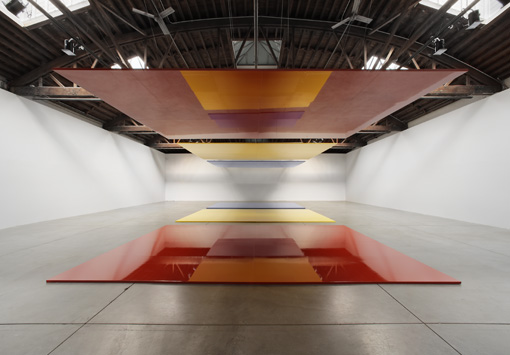
The famous Installation artist Robert Irwin in his book “Robert Irwin" (by The Museum of Contemporary Art, Los Angeles) shares a thoughtful breakthrough he experienced as a young artist. 

Robert Irwin, 1971                                            His Walker Installation                    .
He had been a painter working within the confines of rectangular frames.  Irwin felt that they had “arrived at a point where they had a choice to make: whether to confine themselves to a frame, or break that."  He broke out of the rectangular frame and began his light and space explorations.  These led to numerous installations and lectures that have influenced countless artists and designers over the years.  His questions regarding the common and accepted context of paintings and art have led to an amazing body of work that has continued to develop for over forty years.  He was even invited by NASA in 1969 to work with a symposium on space design and habitability for long term space travel.

Robert Irwin • Who's Afraid of Red, Yellow & Blue? • 2006 • The Pace Gallery, New York


Questions work, and the question of context is a great one.  Add a number of these questions considering context to your next brain sparking list and enjoy where your imagination takes you.


          In a nut shell

   1-Consider questions of new and different context
   2-Think of how it changes everything
   3-Go with your imagination


Robert Irwin, 2009
Quote
Robert Irwin

“I tried to paint a painting that didn’t begin and end at the edge.  It broke the frame.”


Opportunity Is Everywhere

In almost every aspect of life creativity can have a significant and positive impact. Many people think of creativity as something only artists or writers use.  Some think of innovation in the world of technology for inventors.  Creativity is much much more.  Creativity can be a perspective on life.  Every minute of life is an opportunity to create something new and something better, whether it be tangible or intangible.

I remember when I was a boy and I forgot to pack my homework assignment that was due that day in school.  My mother explained to me that if I wanted to remember to take something to school I could put it right next to my shoes the night before.  “Wow” I thought “Mom's got some good ideas.”  A simple creative addition to my routine could help overcome a previous shortcoming and make a substantial difference.  These minor insights are creative improvements to life and each is another opportunity to discover, create and share with others.  Seeing the part of life that offers perpetual opportunity to create can bring an excitement and energy to every moment.

Choose to experience the following technique.  Focus on the present, be acutely aware, and ask questions.  Consider the environment you are currently in.  Stop, look around you and begin to ask questions.  Think of how you might want to frame the questions such as “What can be better?” or “What is remarkable about this space?” or “What amazing secrets are hiding right here in front of me?” or just begin asking random questions:  How could this keyboard work better with my hands?  How can my chair better position my hands for the keyboard?  How can I be more comfortable?  How can I be more energized?  What would help me think more clearly?  What would be a great way that I could help someone right now?  Why is this phone shaped the way it is?  What would be a completely new way to use a printer?  What do most people hate about computers?  What do most people love about computers? and so on.  Each question entices your brain to create answers.  It’s the way your brain was designed.  It wants to solve problems, answer questions and find patterns.  Each question is like a dog treat for your brain.  When it sees a question it likes, it starts to wag it’s tail and look for answers.
Notice also the many different areas of your life that offer creative opportunities.  Consider the following areas as questions to jump start your awareness of how many there are:  How do you communicate with family and coworkers?  How do you spend time in your car?  How do you sleep?  How do you choose to see people around you?  How do you eat?  How do you wake up in the morning?  How do you read?  How do you remember things?  How do different people in your life see you?  How are you valuable to others?  How do you learn?  Each of these areas begs for creative insight and improvement.  They also present opportunities for you to offer value and connect with others.  Others face problems in similar areas and they are hungry for creative insights and solutions.  So be open to the many opportunities life presents you to be creative and give your brain lots of dog treats daily.


          In a nut shell

   1-Creative opportunity is everywhere, tangible and intangible
   2-Focus on the present, be acutely aware and ask questions
   3-Notice your areas of creative opportunity and be open to them


Quotes
Clint Eastwood

 “In school, I could hear the leaves rustle and go on a journey.”

"I don't believe in pessimism. If something doesn't come up the way you want, forge ahead. If you think it's going to rain, it will."


Videos
If you are not familiar with Edward de Bono he is well worth looking into.  He has written many books in the area of creative thinking such as “Lateral Thinking” and “Six Thinking Hats” and his lectures have been heard around the world.  In the following videos he presents his “Six Thinking Hats” in a classic presentation he did years ago.  It will open your eyes to many new thoughts and insights as to how we think and it will give you a number of valuable tools you can incorporate into your creative processes.