When considering the creative process, creatively consider making new processes. A new process will take your mind to new places and it can be a new way to look at old problems. Stand back from your current methods and processes. Break them down and analyze them. With an understanding of them begin to develop and design entirely new ones. Experiment with systems that have never been tried before. Outline or describe the new approach and see where it takes you. As you experience your new processes you can refine and improve them. You will find that each new process gives you fresh perspectives for numerous creative challenges.
There are many tried and true creative processes that have been developed as well and they too are worth exploring.
The famous artist/musician David Bowie occasionally speaks about a method he likes to use when writing songs. He writes down words that he finds intriguing and collects them up over time. He then cuts the words up so that each word is on an individual piece of paper. He spreads the words out in front of him and begins to experiment with different; combinations, orders, rhythms and so on. He eventually works these into lyrics, songs and music.
. Albrech Durer Wood Cut Leonardo da Vinci
Fifteenth century Leon Battista Alberti developed a process for artists to view and grasp the correct perspective of a scene by observing it through a thin veil with a see-through grid (as seen in the Albrech Durer image above). Leonardo da Vinci used and further developed similar contraptions as did many artists of the time.
Dr. Yoshiro Nakamatsu (the famous Japanese inventor) likes to submerge himself underwater with a pad and underwater writing instrument. He feels it helps him think more creatively and he is able to write his thoughts down as they come.
Explore process as you develop your work. Research the processes of people that you respect. Try them, refine them and make your own unique systems to enhance your creativity. It’s always an interesting exercise and it rarely disappoints in producing great results.
In a nut shell
1-Consider new creative processes
2-Analyze your current processes
3-Research other people’s processes
4-Make and use new ones
5-Refine and improve them
Quotes David Bowie
“There’s nothing more embarrassing than watching somebody who doesn’t love what they do, but does it because they believe that’s the way they’re going to be loved.”
“I've never responded well to entrenched negative thinking.”
Videos
Yoshiro Nakamatsu holds a world record for receiving the most patents (over 3000). From the karaoke machine to the DVD he has played a major role in many of the inventions we are all familiar with. In the following video clip he shares one of his techniques for promoting “higher” inventive thinking. It’s a clip from the documentary The Invention of Dr Nakamats. He’s funny but he’s no joke.
Daniel Rozin is an interactive digital artist. He creates installations and sculptures that respond to the viewer in very unique ways. He is also the owner of Smoothware Design, a software company that makes his interactive art possible.
In a previous post I explained the value of sparking the brain’s natural tendency to create by asking it questions. This week I want to share with you a specific question that is almost always worth asking and I have included some videos that beautifully demonstrate the amazing results of asking it. The question is based on context. What ever it is you’re developing or working on ask yourself the question: “What if this were in a completely new or different context?”.
The following video gained world wide recognition. Music and choreographed dance was performed in a new and different context. Rather than on a stage in the usual theater setting, they performed in the middle of Liverpool Street Station. Notice the completely new ways people experience the dancing because of it’s unique context. To date this video has been viewed over twenty four million times and has led to many similar performances.
The Opera Company of Philadelphia decided to share their music in a similar way with “Random Acts of Culture” (the Knight Foundation’s "national initiative to bring the classics out of the performance halls and onto the streets"). Their performance connects with people in a new and profoundly different way. Again, like the dance in Liverpool Street Station, videos of the performance are shared online by millions of people around the world. Millions of people who may never have considered buying a ticket to an opera felt enough connection to this performance to share it via YouTube with a friend or family member. This is the kind of impact you can have by asking the question “What about context could be different or new?”
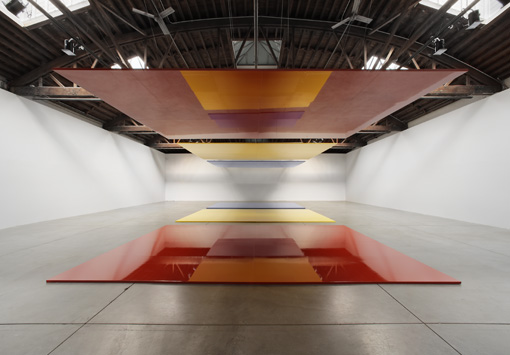
The famous Installation artist Robert Irwin in his book “Robert Irwin" (by The Museum of Contemporary Art, Los Angeles) shares a thoughtful breakthrough he experienced as a young artist.
Robert Irwin, 1971 His Walker Installation .
He had been a painter working within the confines of rectangular frames. Irwin felt that they had “arrived at a point where they had a choice to make: whether to confine themselves to a frame, or break that." He broke out of the rectangular frame and began his light and space explorations. These led to numerous installations and lectures that have influenced countless artists and designers over the years. His questions regarding the common and accepted context of paintings and art have led to an amazing body of work that has continued to develop for over forty years. He was even invited by NASA in 1969 to work with a symposium on space design and habitability for long term space travel.
Robert Irwin • Who's Afraid of Red, Yellow & Blue? • 2006 • The Pace Gallery, New York
Questions work, and the question of context is a great one. Add a number of these questions considering context to your next brain sparking list and enjoy where your imagination takes you.
In a nut shell
1-Consider questions of new and different context
2-Think of how it changes everything
3-Go with your imagination
In almost every aspect of life creativity can have a significant and positive impact. Many people think of creativity as something only artists or writers use. Some think of innovation in the world of technology for inventors. Creativity is much much more. Creativity can be a perspective on life. Every minute of life is an opportunity to create something new and something better, whether it be tangible or intangible.
I remember when I was a boy and I forgot to pack my homework assignment that was due that day in school. My mother explained to me that if I wanted to remember to take something to school I could put it right next to my shoes the night before. “Wow” I thought “Mom's got some good ideas.” A simple creative addition to my routine could help overcome a previous shortcoming and make a substantial difference. These minor insights are creative improvements to life and each is another opportunity to discover, create and share with others. Seeing the part of life that offers perpetual opportunity to create can bring an excitement and energy to every moment.
Choose to experience the following technique. Focus on the present, be acutely aware, and ask questions. Consider the environment you are currently in. Stop, look around you and begin to ask questions. Think of how you might want to frame the questions such as “What can be better?” or “What is remarkable about this space?” or “What amazing secrets are hiding right here in front of me?” or just begin asking random questions: How could this keyboard work better with my hands? How can my chair better position my hands for the keyboard? How can I be more comfortable? How can I be more energized? What would help me think more clearly? What would be a great way that I could help someone right now? Why is this phone shaped the way it is? What would be a completely new way to use a printer? What do most people hate about computers? What do most people love about computers?and so on. Each question entices your brain to create answers. It’s the way your brain was designed. It wants to solve problems, answer questions and find patterns. Each question is like a dog treat for your brain. When it sees a question it likes, it starts to wag it’s tail and look for answers.
Notice also the many different areas of your life that offer creative opportunities. Consider the following areas as questions to jump start your awareness of how many there are: How do you communicate with family and coworkers? How do you spend time in your car? How do you sleep? How do you choose to see people around you? How do you eat? How do you wake up in the morning? How do you read? How do you remember things? How do different people in your life see you? How are you valuable to others? How do you learn? Each of these areas begs for creative insight and improvement. They also present opportunities for you to offer value and connect with others. Others face problems in similar areas and they are hungry for creative insights and solutions. So be open to the many opportunities life presents you to be creative and give your brain lots of dog treats daily.
In a nut shell
1-Creative opportunity is everywhere, tangible and intangible
2-Focus on the present, be acutely aware and ask questions
3-Notice your areas of creative opportunity and be open to them
“In school, I could hear the leaves rustle and go on a journey.”
"I don't believe in pessimism. If something doesn't come up the way you want, forge ahead. If you think it's going to rain, it will."
Videos If you are not familiar with Edward de Bono he is well worth looking into. He has written many books in the area of creative thinking such as “Lateral Thinking” and “Six Thinking Hats” and his lectures have been heard around the world. In the following videos he presents his “Six Thinking Hats” in a classic presentation he did years ago. It will open your eyes to many new thoughts and insights as to how we think and it will give you a number of valuable tools you can incorporate into your creative processes.
An important factor to consider in the enhancement of your creativity is your ego (let it go). By ego I mean the part of you that doesn't like to look dumb or foolish (or whatever words your ego uses). It’s worth realizing that a large part of creativity stems from your ability to comfortably look foolish. Paradoxically there are no foolish ideas in the realm of creative thinking, only ideas that lead to other ideas and/or spark further creativity.
Young Thomas Edison
Thomas Edison performed about ten thousand different experiments leading up to the electrical light bulb. He said of his work “I have not failed. I've just found 10,000 ways that won't work.” He said of failure “Show me a thoroughly satisfied man, and I will show you a failure.” He knew that it was only a matter of time before he was able to achieve his objective and that dissatisfaction leads to exploration and discovery. This is a great way to look at any creative idea or developing vision that you may have. Great work is often developed through trial and error (not just trial). It's important to realize that each failed attempt is loaded with valuable information and it's your job to use that information as you continue to move forward.
If you're overly concerned about how a particular idea, once presented, might make you look then you will not be free to explore. If that idea turns out to be a temporary setback or short-term failure you will be unable to present or even to create unique original ideas because of your fear. It's for this reason that you want to intentionally choose to look foolish and actually enjoy the possibilities looking foolish presents to you. Know that by doing this you will be stepping outside normal, boring conventional thought and into a fresh exploration of the great uncharted imagination. You will be tapping into the wide open spaces of visionary thought rather than getting caught up in a petty ego restraint.
As you explore leave the part of you that thinks it’s important not to look bad behind. Remember that it's in your acceptance of looking foolish where you will discover your freedom to create. A good creativity exercise worth practicing is to intentionally develop ideas that are outrageous, crazy, and "foolish". Alone or with a group set some rules for unbridled outrageousness. Then begin intentionally being wild, outrageous, crazy, and "foolish" in your creativity. Fast and outrageous ideas frequently lead to serious breakthroughs. Don’t force it, just have fun and let it happen. Innovate, create, have fun and be the fool with amazing results.
In a nut shell
1-Put your ego away
2-Explore uncharted imagination
3-Know that breakthroughs are waiting for you
4-Release the outrageous
5-Enjoy the breakthroughs
Quote David Kelly
“If you don’t work under time constraints you could never get anything done because it’s a messy process and it could go along forever.”
Video IDEO is a product development firm and they know creativity. They are the experts in the process of how you design stuff.
A basic and very effective approach to consider when you want to be creative is to simply start working. If you're an artist, begin working the materials you intend to create with. If you are a writer begin writing. The action of writing random thoughts can begin to opened things up in your mind and help you to flow.
It’s not important to have everything in order, or to have a set of clear ideas, or to be in the mood, or to feel inspired. Just begin working and the very act of doing will often cause the creative stars to align for you. I have experienced far too many people frozen in their need to have everything "just right" before they begin to create. They are convinced that they need just the right tool, or just the right idea, or just the right inspiration, or just the right motivation, or they need a better studio, or better instrument, or better lighting, or better teammates, and so on, and so on, and so on... You get the picture. It gets really ugly. Don't fall into this trap.
I have so often been amazed at the power of a deadline to spark creativity. The pressure to have something to show at your next meeting can cause a creatively stifled person to push forward into the light. If you are feeling dead in the water, find some people that will hold you accountable and set a deadline for yourself. Tell them that you will have a spectacular presentation of your work on that date and take action. You will discover the creativity that blossoms out of pressure, frustration and personally forced activity. Chuck Jones (the animator, artist, screenwriter, producer, director and Oscar winner) said that "Creative work is the most frustrating of all human vocations, and it is the only one." Accept the challenge and start working by working.
In a nut shell
1-Simply begin to work
2-Don't get trapped in perfectionism
3-Set a deadline and arrange some accountability
4-Start working by working
Quote Chuck Close
“I always thought that inspiration is for amateurs. The rest of us just show up and get to work. If you wait around for the clouds to part and a bolt of lightning to strike you in the brain. You’re not going to make an awful lot of work. ”
Videos Chuck Close has been creating some remarkable work since the 1970s. The following video is a good way to learn more about the artist and his work. He has many valuable insights into the process of making art and he is an artist worth exploring further. Chuck Close Books
Sir Ken Robinson discusses creativity, education and life. He makes some excellent points about the way we learn and the increasing importance of creativity in today's world.
When I was younger and attending the College for creative studies I noticed a number of very talented students that had developed their chosen set of skills to a very high level. If they had chosen oil painting as their favorite medium their ability to represent things in oils was very impressive. If they were painting a figure they could represent that figure with amazing accuracy and if they were painting a still life that still life would be beautifully represented as well.
It became clear over time however, that many of these students had great difficulty being creative with their skill. As long as the instructor told them what to do (ie: “Paint this still life." or "Paint that landscape.") they were OK. But when they were given complete creative freedom to develop their own subject matter, style and overall direction many were often frustrated and confused. It became evident that the skill of execution did not always come with a natural creative ability, and in reverse, many wildly creative students had trouble representing their ideas in reality.
That being said, there were those rare occasions when I met students that were very talented in both creative thinking and execution and it was these students that would consistently produce the most outstanding work in the school. It is because of this that I believe you should always work hard to maintain a balance as you develop your creativity and your chosen medium of execution. If you know that your "skill of execution" is far beyond your creativity, develop your creative thinking skills. If on the other hand your creativity is beyond your ability to execute, practice practice practice your execution. Each will enhance the other and you will find yourself flowing with ideas that translate beautifully into your area of work.
In a nut shell
1- Talented execution and creative thinking don't always come together
2- Be acutely aware of your abilities in both areas
3- Focus on developing the weaker of the two
4- Find a healthy balance and let them enhance each other
“It is better to have enough ideas for some of them to be wrong, than to be always right by having no ideas at all.”
Video
Photographer Andrew Zuckerman has put together an amazing collection of photographs. The following video is only a behind the scenes short of his website and book project. His website should not be missed. Click on the preceding link, click OK to the copyright and browse his "Photographs" link. You will be amazed. I have never been personally interested in birds but I found his website extremely captivating.
Most of us have had moments of heightened creativity in which we seem to flow for a period of time. If you have had a similar experience such as this then you know the amazing productivity and positive results that can be achieved. Wouldn’t it be great if such experiences were less random and you could choose to flow creatively at will?
Working for years in fine arts and architecture I have had to develop an ability to work myself into a creative flow on a daily basis. When I was unable to do this my work and productivity would suffer greatly. One of my most effective methods in doing this has been something I call my “Creativity Ritual”.
When I would find myself in a “creative zone” I would observe just exactly what I was experiencing. I began to write down what I was feeling, how I was thinking, the way I sat or stood, the way I was breathing and so on. I later organized these “ways of being” into an outline that has evolved into my personal “Creativity Ritual”. It is with this “way of being” outline that I have gained a tremendous amount of control over my ability to put myself into a creative zone when needed.
Your individual “Creativity Ritual” should be very uniquely yours. It should be based on personal observations of how you are being when you are at your most creative. It’s about taking the time to discover your creative self in action so you can replicate your state of mind when you choose to. To help you better understand how this might look for you I have included the following outline of my current “Creativity Ritual”.
Being Creative:
•I stand up and breath in deeply.
•I feel creative energy filling my lungs
•I thank God for my imagination and the opportunity to be creative.
•I consider great thoughts from great people.
•I consider creative people’s work.
•I feel and imagine my work’s creative potential.
•I think about the possibilities like a big kid.
•I feel unstoppable creativity welling up inside me.
•I breath deeper and more fully.
•I sit or stand straight, energized and excited.
•I move fast and sure
•I think clear and sure
•I feel the truth and excitement of my purpose.
•I move away from safety and protection.
•I feel passion for the unknown benefits to come.
•I pray for the pessimists and critics that they might feel the joy of taking risks.
•I work hard and move my dreams forward.
•I dive into a creative zone as if it's refreshing, crystal-clear water.
It's inviting, exciting and natural.
By going through this list and doing each item physically and mentally I am able to work my way into a creative zone. This ritual of mine has changed and evolved over time. When I find myself in a creative zone I continue to observe and note new helpful ways I can replicate the experience and I add them to my Being Creative list. Begin developing your “Creativity Ritual” and discover the remarkable control you can have over your own ability to dive into a creative zone at will.
In a nut shell
1-Experience being in a creative zone
2-Observe how you are feeling, thinking and being
3-Note and organize your observations
4-Use these written observations to replicate the experience
5-Follow them physically and mentally back into a creative zone
“All external expectations, all pride, all fear of embarrassment or failure, these things just fall away in the face of death leaving only what is truly important. Remembering that you are going to die is the best way I know to avoid the trap of thinking you have something to lose. You are already naked, there's no reason not to follow your heart.”
Videos
British artist Patrick Hughes is the creator of “Reverspective” a unique form of three-dimensional painting that has to be seen in motion to truly appreciate. Using his technique of reverse perspective by inverting the depth of his painting’s surface he creates powerful illusions.
A great way to enhance creativity is to fill your mind with lots of stuff and by stuff I mean lots of things that relate to the areas you want to be creative in. The idea is to expose yourself to a wide range of raw creative material. If you are an artist, look at lots of art. Spend time in museums and galleries, experience art shows and artists, and put a certain amount of time into browsing the internet.
Remember also the importance of stepping outside your world and looking into other seemingly unrelated areas for fresh creative ideas. Creative breakthroughs often occur when seemingly unrelated things come together in a new way. If you embrace this perspective and let it become part of your daily experience it will open your eyes to things you might not otherwise see. Steven Johnson (Author of Where Good Ideas Come From) touches on this in the following video.
An example of this stepping out benefit is the discovery years ago that knots (like when you tie your shoes) play a significant role in understanding DNA and the genetic instructions they contain.
Another example is Guido Daniele’s hand paintings. He paints animals on hands rather than canvas creating something much more interesting and unique.
Begin filling your mind with this open perspective and note the new levels of creativity that come. They will often come during simple daily activities that need little mental focus. You may be showering, driving to work or vacuuming the floor. Be open to your creativity and comfortably let it happen. Know that breakthrough ideas are floating about your mind. You have filled it with lots of raw creative material and it’s natural state is to create. When an idea comes don’t judge it, instead simply make note of it. Always have a way to capture your new ideas whether it be a sketchbook, a journal or even a voice recording. Know that collecting these little gems will lead to even greater breakthroughs if they are not breakthroughs already.
In a nut shell
1-Fill your mind with lots of "good stuff"
2-Include “seemingly unrelated” stuff with an open mind
3-Let the ideas come to you while doing simple activities
4-Comfortably capture the ideas (sketch book, note, voice memo, etc.)
5-Let them lead to creative breakthroughs
“A moment's insight is sometimes worth a life's experience."
"The human mind once stretched by a new idea never goes back to its original dimensions."
Video I recently was able to fill my mind with lots of amazing creative material at ArtPrize 2010. My wife and I spent the weekend in Grand Rapids, Michigan enjoying top-notch art, entertainment and food at this inspiring event. ArtPrize is the world's largest art prize awarding almost a half a million dollars to the top ten artists. According to their website www.ArtPrize.orgthe competition drew 1,713 artists from 44 states and 21 countries. Note David Spriggs three dimensional light piece near the end. Imagine the fun he had taking his idea from concept to reality. I’m sure he made many exciting discoveries in the process and he took 5th place over all in the competition. First place went to Chris LaPorte for his meticulously drawn “Cavalry, American Officers, 1921” (also in this video).
Working as a fine artist and designer for over twenty years it has been my job to develop and implement creative ideas. When seeing my finished work people often ask me “Where does an idea like that come from?” Specific answers for each individual idea can be complicated but the creative lessons, techniques, and strategies are often simple and anyone can benefit from their use.
Ihave studied creative people and their methods, taught classes, headed up teams, and read piles of books on creativity. This interest over the years has led to daily explorations of the creative process in art shows and galleries as well as online and in my studio. With this website I can now share the best of my discoveries in writings, pictures, videos and links. If you are looking for creative inspiration and personal hands on creative improvement, this site is for you. Be sure and check back often. I am committed to adding fresh, valuable content regularly that will help you achieve your creative goals.
In a nut shell
1-It's for your creativity
2-I know this stuff and I continue to explore
3-I'm going to share my discoveries
(in writings, pictures, videos and links)
4-Check back weekly for new stuff
“We can't solve problems by using the same kind of thinking we used when we created them.”
“Imagination is everything. It is the preview of life's coming attractions.“
“A person who never made a mistake never tried anything new."
Video For Creativity's Weekly Videos I am amazed at how many videos out there demonstrate remarkable creativity. Some are inspirational, others are practical hands-on and instructional. I believe these are essential to enhancing creativity so I plan to share with you at least one each week. I will include videos with each post and I will always make sure they are well worth your time. Enjoy.
Theo Jansen presentation at the Creativity World Forum in 2008. He creates walking kinetic sculptures that range in size from that of a small dog to as big as an elephant. This video is about 8 minutes showing his work and his valuable thoughts behind it.

 The famous artist/musician David Bowie occasionally speaks about a method he likes to use when writing songs. He writes down words that he finds intriguing and collects them up over time. He then cuts the words up so that each word is on an individual piece of paper. He spreads the words out in front of him and begins to experiment with different; combinations, orders, rhythms and so on. He eventually works these into lyrics, songs and music.